

7 Spooky Flooring Problems That Could Come Back to Haunt Your Installation
Posted by Yasmin on 1st Oct 2026
7 Spooky Flooring Problems That Could Come Back to Haunt Your Installation
A flooring installation can look perfect on day one, but problems hiding beneath the surface can sometimes appear later.
From excess moisture and poor subfloor preparation to choosing the wrong adhesive, small mistakes during installation can cause much bigger problems further down the line.
This Halloween, we're looking at seven flooring problems you definitely don't want coming back to haunt your installation – and how good preparation can help avoid them.
1. What Happens If You Don't Check the Subfloor for Moisture?
Moisture is one of the first things to consider before installing a floor covering.
Excess moisture within a subfloor can affect flooring systems and lead to problems with adhesives, levelling compounds and the finished floor. The correct moisture assessment method will depend on the substrate and flooring specification.
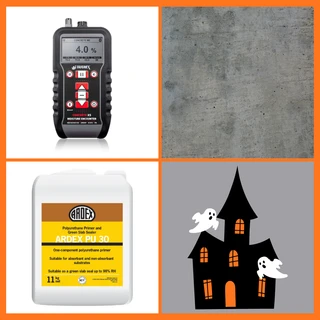
Professional moisture-testing equipment, including Tramex moisture meters, can be used as part of the assessment process before installation.
Where residual construction moisture is present, an appropriate moisture-control system may also be required. Ardex PU 30, for example, can be used as a moisture barrier on cement screeds and concrete within Ardex's specified moisture limits.
2. What Happens If You Use the Wrong Primer?
Priming isn't simply another box to tick during floor preparation. The primer needs to be appropriate for both the substrate and the products being applied over it.
Porous concrete, non-porous surfaces and calcium sulphate screeds can all require different preparation.
The Kelmore PrimeMore range includes products designed for different backgrounds, while Ardex PU 30 can also be used as a primer, substrate consolidator and, in specified applications, a moisture barrier.
Always follow the technical data sheets for the primer and levelling compound you're using.
3. Do You Have to Remove Every Trace of Old Adhesive?
Not necessarily – but don't assume you can simply cover it up.
Remaining adhesive needs to be assessed before a levelling compound is applied. Loose, soft or poorly bonded material can compromise the preparation system and should be dealt with appropriately.
Some levelling compounds are specifically suitable for refurbishment work. Kelmore LevelMore Absolute 30, for example, is approved by Kelmore for use over hard, sound and well-adhered old adhesive residues, including bitumen, provided they are not softened by water.
This makes identifying what's already on the floor an important part of preparation.
4. Why Is My Levelling Compound Cracking or Pinholing?
Cracks and pinholes can have several causes rather than one simple explanation.
Problems may relate to the condition or porosity of the substrate, incorrect preparation, mixing, trapped air, application depth or site conditions.
Each levelling compound has its own specified application depths, mixing instructions and preparation requirements. Applying a product outside those parameters can affect its performance.
Correct mixing equipment matters too. A professional Collomix mixer and suitable mixing paddle can help installers achieve the consistent, lump-free mix required by the levelling compound manufacturer.
Where specified and suitable for the application depth, a spiked roller can also help remove trapped air from freshly applied compound.
5. What Happens If You Choose the Wrong Flooring Adhesive?
Not every flooring adhesive performs the same job.
The correct adhesive depends on factors including the floor covering, substrate, installation method and site conditions.
For example, within the Ardex flooring adhesive range:
- Ardex AF145 can be used as a pressure-sensitive or wet-set adhesive for specified resilient floor coverings.
- Ardex AF175 is a fibre-reinforced adhesive designed for LVT and helps minimise lateral movement during installation.
- Ardex AF195 is a fibre-reinforced, high-temperature LVT adhesive designed for installations subject to higher temperatures.
Always check the flooring manufacturer's requirements alongside the adhesive manufacturer's current technical guidance before installation.
6. Why Are My LVT Planks Moving?
Movement in an LVT installation can have several potential causes, so it shouldn't automatically be blamed on the flooring itself.
The subfloor condition, adhesive selection, application method, installation environment and correct conditioning of the floor covering can all be relevant.
For intricate LVT installations, adhesive choice can become particularly important. Ardex AF195, for example, offers an extended working time of up to approximately 30 minutes, which can be useful when installing more detailed layouts such as parquet or herringbone, where its specification is appropriate.
The LVT manufacturer's installation instructions should always be followed.
7. Can Poor Subfloor Preparation Show Through LVT?
Yes. LVT is relatively thin, so the quality of the finished installation is heavily influenced by the surface underneath it.
Uneven areas and imperfections may affect the appearance of the finished floor, which is why achieving a suitably smooth and level surface is an important part of LVT preparation.
The preparation process could involve:
Assess the substrate → Repair damaged areas → Prime where required → Apply a suitable levelling compound → Install the floor covering
Products such as Kelmore Feather can be used for localised patching and smoothing, while the Kelmore LevelMore range provides options for larger levelling and smoothing applications.
Professional preparation tools, including Collomix mixers and paddles, CAM rakes and spiked rollers, can then help with the application process.
Don't Let Poor Preparation Haunt Your Next Installation
Many flooring problems begin before the finished floor covering is installed.
Taking the time to assess moisture, inspect the substrate, select the correct preparation products and follow manufacturer guidance can help reduce the risk of problems appearing later.
At Floormart, we stock professional floor preparation products, adhesives, moisture-testing equipment and installation tools from brands including Kelmore, Ardex, Tramex and Collomix, helping installers prepare for every stage of the job.