

Is Moisture Hiding Under Your Floor? The Invisible Problem That Can Haunt an Installation
Posted by Yasmin on 7th Oct 2026
Is Moisture Hiding Under Your Floor? The Invisible Problem That Can Haunt an Installation
A subfloor can look perfectly dry and still contain moisture that could cause problems after the finished floor has been installed.
Unlike cracks, contamination or uneven areas, moisture isn't always visible during preparation. Recent flooring-industry guidance continues to highlight subfloor moisture as a significant cause of flooring failures in the UK.
So, this Halloween, we're looking at one flooring problem that's particularly good at hiding beneath the surface.
What Happens If a Subfloor Is Too Damp?
Installing a floor covering before the substrate is sufficiently dry can affect different parts of the flooring system.
Depending on the floor covering and installation system, excess moisture can contribute to problems such as:
- Adhesive breakdown or loss of bond
- Lifting or bubbling resilient flooring
- Problems with levelling and smoothing compounds
- Movement in moisture-sensitive floor coverings
The difficult part is that the surface can look and feel dry even when moisture remains within the substrate.
How Do You Know If Moisture Is Hiding in the Subfloor?
Don't rely on appearance alone.
The subfloor should be properly assessed using moisture-testing equipment and the test method appropriate for the substrate and flooring system.
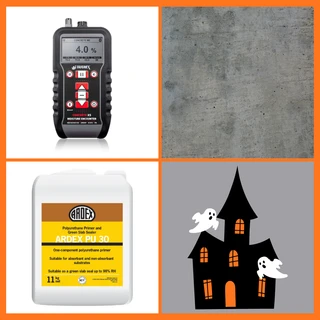
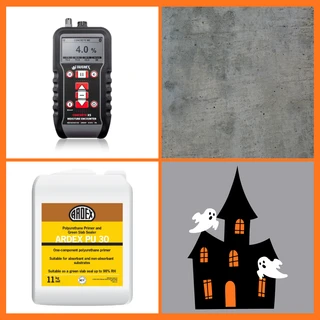
Professional equipment from Tramex can be used as part of the moisture-assessment process. This can help installers identify potential moisture concerns before primers, levelling compounds, adhesives and floor coverings are applied.
Think of moisture testing as the investigation before the installation – finding what's hiding underneath before it has an opportunity to cause trouble later.
What If the Moisture Level Is Too High?
A high reading doesn't necessarily mean the entire project has to stop indefinitely.
Depending on the substrate, moisture source, readings and flooring specification, an appropriate moisture-control system may be available.
One option stocked by Floormart is Ardex PU 30.
PU 30 is a single-component polyurethane product that can act as a primer, substrate consolidator and moisture barrier. Ardex specifies it as a moisture barrier against excessive residual moisture on cement screeds and concrete up to defined limits.
However, it's important to establish where the moisture is coming from. PU 30 isn't designed to deal with penetrating or rising moisture and doesn't replace structural waterproofing.
Don't Forget the Rest of the Subfloor
Moisture isn't the only thing that can be hiding underneath an old floor covering.
Once the existing flooring is removed, installers may also uncover:
Old adhesive residues → Cracks → Uneven areas → Weak surfaces → Contamination
These need to be assessed before moving on to priming and levelling.
Products such as Kelmore Feather can be used for suitable localised repairs, while the Kelmore LevelMore range provides options for larger levelling and smoothing applications.
A Simple Pre-Installation Checklist
|
Check |
What You Might Need |
|
Moisture |
Tramex moisture-testing equipment |
|
Residual moisture treatment |
Ardex PU 30 where suitable |
|
Damage & imperfections |
|
|
Substrate preparation |
Appropriate Kelmore PrimeMore primer |
|
Uneven floor |
|
|
Mixing & application |
Collomix mixer, paddle & preparation tools |
Don't Let Hidden Moisture Haunt Your Installation
The finished floor is only part of the installation. What is happening underneath it can be just as important.
Testing the substrate, investigating unexpected readings and using the correct preparation system can help identify potential problems before the floor covering goes down.
At Floormart, we stock professional moisture-testing and floor-preparation products from Tramex, Ardex, Kelmore and other specialist flooring brands.