

Do I Need to Remove Old Adhesive Before Applying Levelling Compound?
Posted by Yasmin on 16th Sep 2026
Do I Need to Remove Old Adhesive Before Applying Levelling Compound?
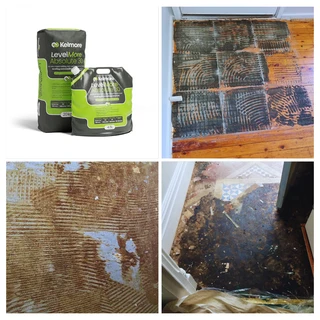
Removing an old floor covering often leaves adhesive behind on the subfloor. Before installing new flooring, you may need to apply a levelling and smoothing compound – but does every trace of the old adhesive need to be removed first?
Not necessarily. Whether you can apply a levelling compound over old adhesive depends on the condition of the residue, the substrate underneath and, most importantly, the requirements of the levelling compound you're using.
Can You Apply Levelling Compound Over Old Adhesive?
Some levelling and smoothing compounds are specifically designed for application over old adhesive residues.
For example, Kelmore LevelMore Absolute 30 is suitable for use over old adhesive residues, including bitumen.
However, Kelmore specifies that any remaining adhesive residues must be:
- Hard
- Sound
- Well adhered
- Not softened by water
This means you shouldn't simply pour a levelling compound over an old floor without assessing it first.
When Should Old Adhesive Be Removed?
Any material that could affect adhesion needs to be dealt with during subfloor preparation.
Loose, soft, weak or poorly bonded adhesive residues shouldn't be treated as a suitable base for a new flooring system. The same applies to other contaminants that could interfere with adhesion.
The aim is to create a clean, sound and stable substrate before applying the next preparation product.
If you're unsure about the type or condition of an existing adhesive, check the technical guidance for the levelling compound you're planning to use before proceeding.
What About Old Bitumen Adhesive?
Black bituminous adhesive residues are commonly encountered when refurbishing older floors.
This is an area where checking product compatibility is particularly important. You shouldn't assume that every levelling compound can be applied directly over bitumen.
Kelmore LevelMore Absolute 30 is specifically listed by Kelmore as suitable for application over old adhesive residues, including bitumen.
It is an ultra-rapid setting, two-part levelling and smoothing compound that can be applied between 2mm and 20mm.
At 20°C, it has a working time of approximately 15 minutes, can be walked on after 30 minutes and can receive resilient floor coverings after approximately 90 minutes.
Do You Need to Prime Before Levelling?
This depends on both the substrate and the levelling compound being used.
Kelmore has different primers for different backgrounds. For example, PrimeMore Universal is designed for porous and absorbent substrates such as concrete and cement:sand screeds, while PrimeMore Grip is a bond-promoting primer for non-porous backgrounds.
You should therefore identify the substrate beneath the adhesive residues and follow the technical data sheet for your chosen levelling compound rather than automatically applying a primer.
Preparing the Floor
Before applying a levelling compound:
- Remove the existing floor covering.
- Assess the condition of the remaining adhesive.
- Remove loose, soft or poorly bonded material.
- Ensure the substrate is clean, sound and free from contaminants.
- Check for moisture and any other subfloor issues.
- Confirm that your chosen levelling compound is compatible with the remaining residue.
- Prime where required by the manufacturer.
- Apply the levelling compound according to its technical data sheet.
Choosing a Levelling Compound for Refurbishment Work
Floors with old adhesive residues can present more challenges than new substrates, so choosing a product specifically designed for refurbishment work can simplify preparation.
Kelmore LevelMore Absolute 30 is a useful option where compatible because it offers:
- Suitability over old adhesive residues, including bitumen
- Application from 2–20mm
- No primer required on several specified substrates
- Moisture tolerance
- Walk-on time from 30 minutes at 20°C
- Resilient floor covering installation from 90 minutes at 20°C
Final Thoughts
You don't always need to remove every trace of old flooring adhesive before applying a levelling compound, but you do need to make sure the remaining residue is suitable to receive the product you're using.
Never assume that a levelling compound can be applied over an existing adhesive. Check the condition of the residue, identify the substrate and follow the levelling compound manufacturer's current technical guidance.
For refurbishment projects involving old adhesive residues, Kelmore LevelMore Absolute 30 provides a fast-setting option specifically approved by Kelmore for use over old adhesive residues, including bitumen.
Explore the Kelmore floor preparation range at Floormart for primers, levelling compounds and other products designed for professional subfloor preparation.